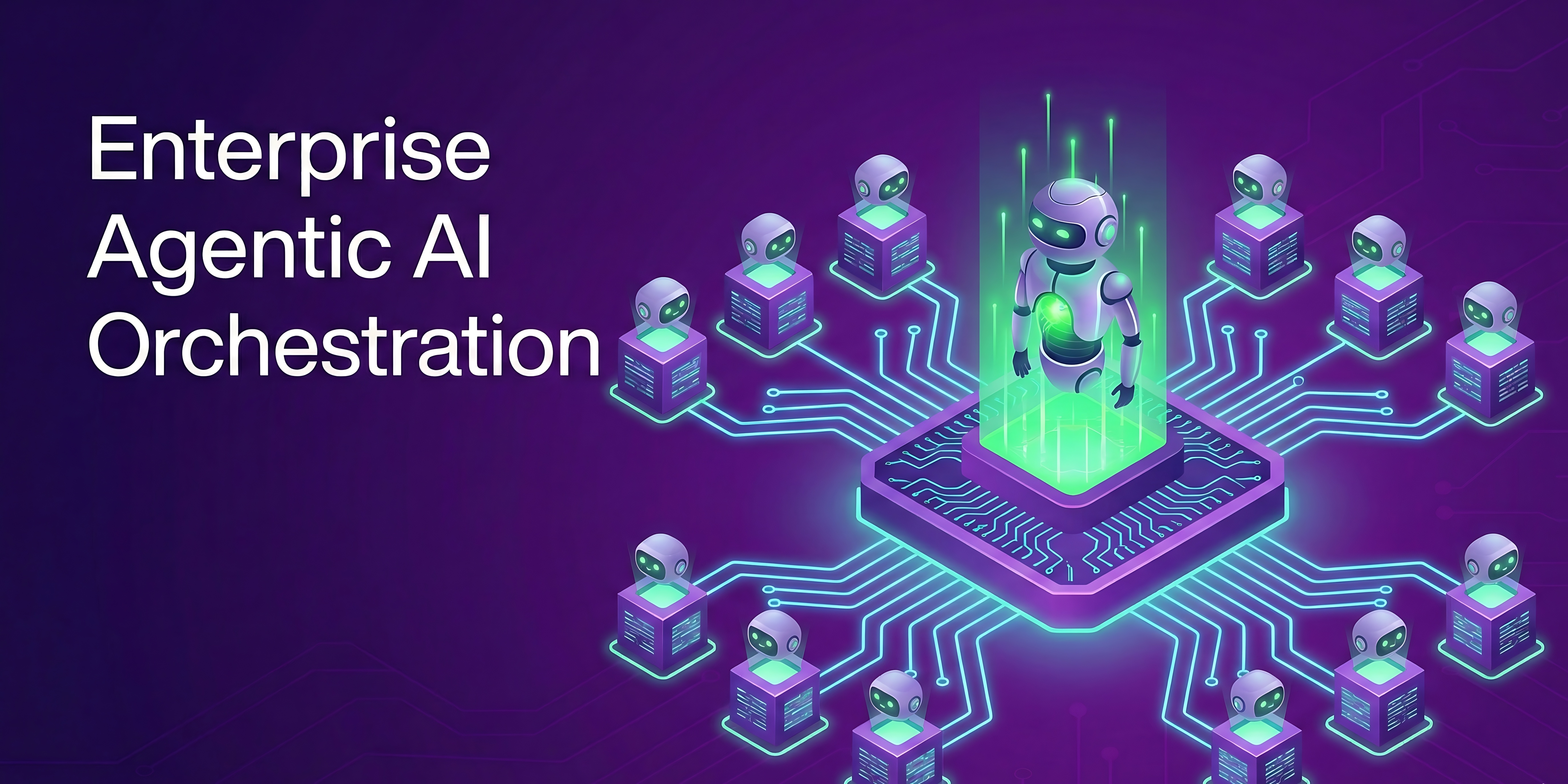
Enterprise Agentic AI Orchestration
A single AI agent answering a prompt is a demo. An enterprise running dozens of agents across finance, operations, and compliance is something else: a system that has to schedule work, pass context between steps, enforce rules, and keep a record of everything that happened. That shift, from one clever model to many coordinated agents, is the orchestration problem.
One agent is easy. A fleet is the hard part.
Most teams start with a useful agent: a document reviewer, a triage assistant, a data lookup. The trouble starts when those agents need each other. A fraud check feeds an approval. A yield alert triggers a recipe change that needs sign-off. Each handoff is a place where context can be lost, a rule can be skipped, or an action can fire without anyone watching.
At that point the question is no longer which model is smartest. It is how the work is routed, what happens when a step fails, and who is accountable when an agent acts.
Orchestration is more than chaining prompts.
Routing: send each signal to the right agent, with the context it needs and nothing it does not.
Coordination: pass results between agents, handle failures, and retry without human babysitting.
Policy: check every action against the rules that apply, before the action runs, not after.
Oversight: pause for a human when confidence is low or the stakes are high.
Record: write a tamper-evident log of every decision, tool call, and approval.
The layers of an agentic stack.
It helps to picture the stack as layers. Business systems like ERP, CRM, and finance sit at the base, where operations actually run. An orchestration layer plans and coordinates work across them. Agents act on top of that. And a human review layer sits above everything, so governance and compliance stay in the loop rather than being bolted on afterward.
Why the operating system analogy holds up.
An operating system does for processes what an enterprise needs for agents: it schedules them, isolates their resources, enforces permissions, and journals what they do. Treating agents as governed processes, rather than as a pile of API calls, gives you a place to put the controls that regulated industries already expect from their critical systems.
That framing also keeps the hard requirements out of each individual agent and into the layer underneath. Policy, audit, and human approval should not be reimplemented by every team shipping an agent. They belong to the runtime.
What this means for deployment.
If agentic AI is going to move from pilots into real operations, the orchestration layer has to be trustworthy on its own terms: policy enforced before each action, a human in the loop where it matters, and a complete record an auditor can read later. Get that layer right and the agents on top become a capability you can actually deploy, not a risk you have to explain.
That is the layer Tenaxis is built to be. If you are working through these problems in your own stack, we would be glad to compare notes.