Runtime Observability for Multi-Stage Agents
A single agent answering a question is easy to follow. You can read its prompt and its reply. A workflow where several agents hand work to each other, call tools, and act on the results is a different thing. By the time something goes wrong, the trail is spread across a dozen steps that no log was designed to connect. Runtime observability is the instrumentation that lets you explain and control what a multi-stage agent did, while it is doing it. [3][5]
What you actually need to see.
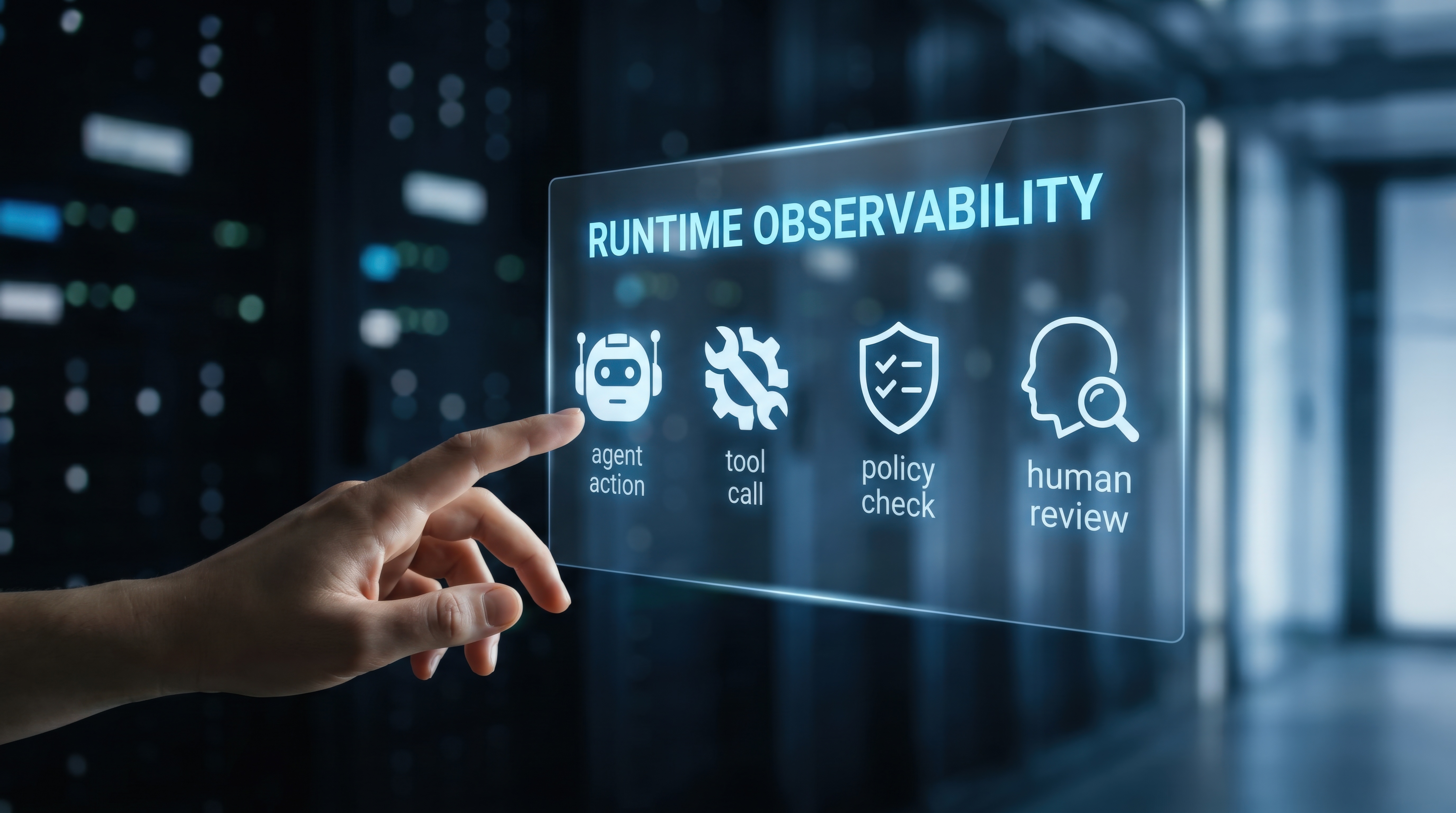
Four signals carry most of the value. Watch these on every step and you can reconstruct any run.
Agent action: which agent did what, with which context, and why it chose that step.
Tool call: which external tool or system was invoked, with which inputs, and what came back.
Policy check: which rules were evaluated before the action, and whether each passed or was blocked.
Human review: where the run paused for a person, what they saw, and what they decided.
Why traces beat logs for agents.
Traditional logs answer what happened on one service. Agent workflows need something closer to a distributed trace: each step carries a unique ID, the inputs it evaluated, the tools it invoked, the policy checks it passed or failed, and the outcome it produced. [1][2][4] Stitched together, those structured records let you replay a run, see where confidence dropped, and find the exact step where a result went off course. That is the difference between knowing an agent failed and knowing why.
Irreversible actions are the whole point.
Observability for agents is not only about debugging. Many agent actions cannot be taken back: authorizing a claim, routing sensitive data, or starting a transaction. [1] Once done, an after-the-fact log does not help. The control has to sit before the action, which is why policy checks belong in the same runtime that emits the trace. You see the decision and you gate it in the same place.
Use-case scenarios.
Finance: a claims approval chain where each agent step, the eligibility check, the fraud signal, the payout decision, is traced and gated before money moves.
Healthcare: a workflow that routes patient records between agents, with PII detection and redaction enforced and logged at every handoff.
IT operations: an incident responder that diagnoses an alert and can restart a service, where the corrective action is policy-checked and recorded before it runs.
Supply chain: a reorder agent that drafts a purchase, with the trace showing the demand signal, the supplier choice, and the approval that released the order.
Make it auditable by default.
The output of good runtime observability is a tamper-evident record that an auditor can read months later: every decision, tool call, policy result, and approval, in order, tied to the run that produced it. Build that into the runtime and audit stops being a project you scramble for and becomes a property the system already has. That is how Tenaxis treats it, so the same trace that helps an engineer debug is the one a compliance team relies on.
Sources and further reading.
- [1]Oracle: Runtime Governance for Enterprise Agentic AI
- [2]Arthur: Agentic AI Observability, A 2026 Playbook
- [3]LogicMonitor: What is Agentic Observability
- [4]groundcover: AI Agent Observability Guide, Telemetry, Traces, Metrics, and Evals
- [5]Kore.ai: AI observability, monitoring and governing autonomous AI agents